
Dead Weight Filter Press: 7 Powerful Benefits for Accurate Fluid Loss Testing
Introduction
Dead Weight Filter Press is one of the most trusted laboratory instruments used in the oil and gas industry for evaluating drilling fluid performance. During drilling operations, controlling fluid loss is essential for maintaining wellbore stability, protecting producing formations, and reducing operational costs. Excessive filtration can cause formation damage, differential sticking, and increased non-productive time (NPT), making accurate testing a critical part of drilling fluid management.
A Dead Weight Filter Press provides a reliable and standardized method for measuring the filtration properties of drilling fluids under controlled pressure. Unlike conventional gas-powered filter presses, it uses calibrated dead weights to apply consistent pressure, resulting in highly repeatable and dependable test results.
At Petropath Fluids India Ltd., we manufacture premium-quality mud testing equipment designed to deliver precision, durability, and long-term performance for both laboratory and field applications. Our Dead Weight Filter Press helps drilling engineers optimize drilling fluid formulations, improve operational efficiency, and ensure compliance with industry testing standards.
What is a Dead Weight Filter Press?
A Dead Weight Filter Press is a laboratory testing instrument specifically designed to determine the filtration characteristics of drilling fluids. The equipment measures the amount of filtrate released from a drilling mud sample while simultaneously evaluating the thickness and quality of the filter cake formed during testing.
The test is performed by applying calibrated dead weights that generate a constant pressure—typically 100 PSI or 500 PSI—over a specified period, usually 30 minutes. Because pressure remains constant throughout the test, the results are more accurate and repeatable than systems that rely on compressed gas cylinders.
This makes the Dead Weight Filter Press an essential instrument for Fluid Loss Testing, Drilling Fluid Analysis, and quality control in drilling operations.
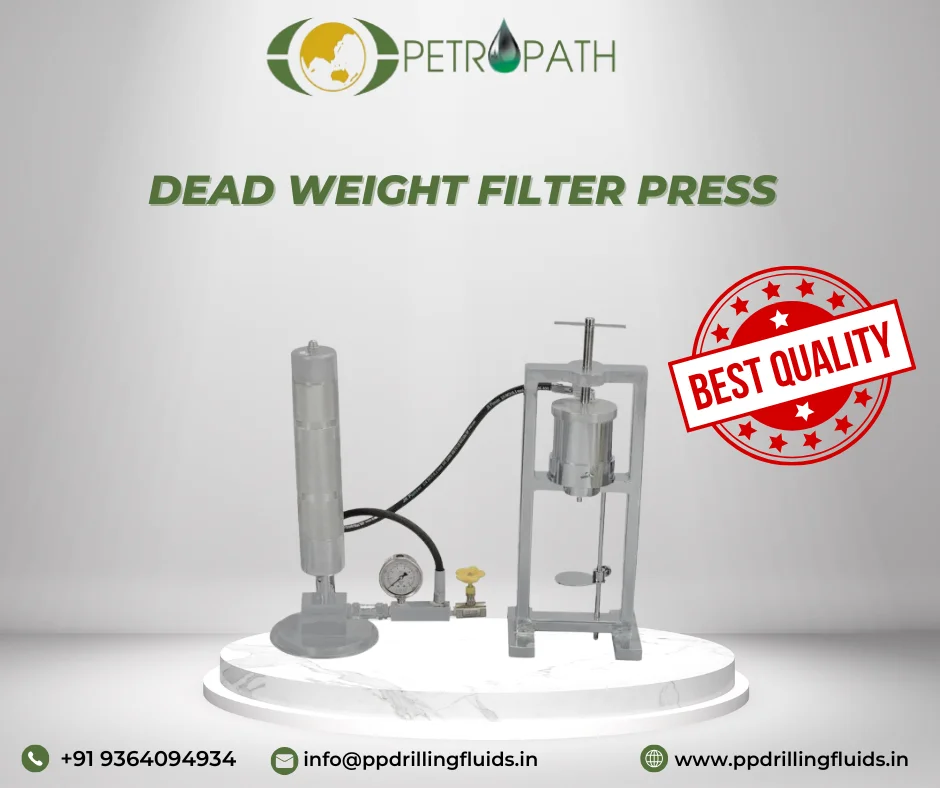
Key Components of a Dead Weight Filter Press
Every Dead Weight Filter Press consists of precision-engineered components that work together to deliver accurate and reliable filtration measurements.
Mud Cell
The mud cell securely holds the drilling fluid sample throughout the testing process while maintaining pressure integrity.
Filter Paper
Special filter paper simulates the permeability of downhole formations, allowing engineers to evaluate filtration performance under standardized conditions.
Calibrated Dead Weights
These accurately manufactured weights apply uniform pressure without requiring external gas cylinders, ensuring consistent testing conditions.
Filtrate Collection Tube
The graduated collection tube measures the volume of filtrate produced during the test, providing accurate quantitative results.
Support Stand and Clamping Assembly
A heavy-duty stand provides stability, operator safety, and secure positioning during laboratory and field testing.
How Does a Dead Weight Filter Press Work?
The operation of a Dead Weight Filter Press follows a simple but highly standardized procedure.
First, the drilling fluid sample is poured into the mud cell. A filter paper is then placed beneath the sample to simulate the permeable formation. After sealing the assembly, calibrated dead weights are positioned to generate the required testing pressure.
The filtration process typically runs for 30 minutes, during which filtrate is collected inside the measuring tube. Once the test is complete, technicians record the filtrate volume and examine the filter cake thickness, consistency, and quality.
These measurements provide valuable information regarding drilling fluid performance and help engineers optimize mud properties before field deployment.
Why Fluid Loss Testing Is Critical
Accurate Fluid Loss Testing plays a major role in successful drilling operations. Excessive filtration allows drilling fluids to invade producing formations, potentially causing permanent reservoir damage.
Using a Dead Weight Filter Press, drilling engineers can identify fluid systems that require improvement before they are circulated into the well.
Key benefits include:
- Reduces formation damage
- Improves wellbore stability
- Prevents differential pipe sticking
- Minimizes non-productive time
- Controls drilling costs
- Enhances drilling efficiency
- Improves overall well performance
Routine testing enables operators to maintain optimum drilling fluid properties throughout every phase of drilling.
Importance in Drilling Fluid Analysis
A Dead Weight Filter Press is one of the most valuable instruments used for Drilling Fluid Analysis. It allows laboratory specialists to evaluate the effectiveness of fluid loss control additives and monitor mud performance under controlled conditions.
Through regular testing, engineers can:
- Evaluate filtration control efficiency
- Optimize polymer concentrations
- Improve mud formulations
- Detect abnormal fluid behavior
- Recommend corrective treatments
- Verify laboratory quality standards
- Support real-time drilling decisions
This analytical capability ensures drilling fluids continue to perform efficiently even under demanding downhole conditions.
7 Powerful Benefits of Using Petropath’s Dead Weight Filter Press
1. Exceptional Accuracy
Calibrated dead weights maintain constant pressure throughout testing, producing highly reliable results.
2. Excellent Repeatability
Unlike gas-powered systems, pressure fluctuations are eliminated, ensuring consistent laboratory data.
3. Heavy-Duty Construction
Manufactured using premium materials, the equipment withstands continuous laboratory and field use.
4. Easy Operation
Simple assembly and straightforward testing procedures reduce operator training requirements.
5. Enhanced Safety
No compressed gas cylinders are required, making operation safer and more economical.
6. Portable Design
Its compact construction allows convenient transportation between laboratories and drilling locations.
7. Industry Standard Compliance
The equipment supports standardized oilfield testing procedures used worldwide.
Applications Across the Oil and Gas Industry
The Dead Weight Filter Press serves numerous applications throughout drilling and research operations.
It is widely used in:
- Oil and gas drilling laboratories
- Mud engineering service companies
- Research and development facilities
- Petroleum universities
- Drilling fluid manufacturing plants
- Quality control laboratories
- Field mud testing units
Its versatility makes it one of the most dependable Mud Testing Equipment solutions available today.
Why Choose Petropath Fluids India Ltd.?
Petropath Fluids India Ltd. has earned a strong reputation for supplying reliable Oilfield Laboratory Instrument solutions that meet the demanding requirements of modern drilling operations.
Our Dead Weight Filter Press is engineered for long service life, precise testing, and dependable field performance. Every unit undergoes strict quality inspection to ensure accuracy, durability, and compliance with industry standards.
In addition to manufacturing high-quality laboratory equipment, our experienced technical team provides expert support for drilling fluid testing, laboratory setup, equipment maintenance, and application guidance.
When accuracy and reliability matter most, professionals trust Petropath for dependable oilfield laboratory solutions.
Best Practices for Accurate Dead Weight Filter Press Testing
To achieve the most reliable testing results, laboratories should follow standard operating procedures every time the equipment is used.
Some recommended practices include:
- Use clean and properly calibrated equipment.
- Replace filter paper before every test.
- Ensure the mud cell is sealed correctly.
- Apply only calibrated dead weights.
- Maintain the recommended testing duration.
- Record filtrate volume accurately.
- Inspect filter cake thickness and texture immediately after testing.
Following these practices ensures consistent results and improves confidence in drilling fluid performance evaluations.
FAQs
Conclusion
A Dead Weight Filter Press remains one of the most important instruments for evaluating drilling fluid filtration properties. Accurate filtration testing enables drilling engineers to improve wellbore stability, reduce formation damage, minimize operational risks, and optimize drilling performance.
With its robust construction, repeatable testing methodology, and dependable pressure application, Petropath Fluids India Ltd.’s Dead Weight Filter Press delivers the precision required by today’s oil and gas industry. Whether used in laboratories, research facilities, or field operations, it provides accurate Fluid Loss Testing and comprehensive Drilling Fluid Analysis that support safer, more efficient drilling projects.
Ready to Improve Your Drilling Fluid Testing?
Partner with Petropath Fluids India Ltd. for high-performance laboratory equipment designed for accuracy, durability, and reliability. Contact our technical team today to learn how our Dead Weight Filter Press can enhance your drilling operations with dependable testing solutions.
Ready to take the next step? Connect with our team today and explore how we can support your operations with reliable solutions tailored to your needs.