
Foam Sticks for Oil & Gas Workover Operations: A Smart Solution for Gas Well Productivity
Introduction
Foam Sticks for Oil & Gas Workover Operations provide a practical and economical way to address liquid loading and declining gas production. In mature, low-pressure, and marginal gas wells, accumulated water and condensate can increase hydrostatic pressure inside the wellbore, restricting gas flow and reducing production efficiency.
When conventional production becomes difficult because of liquid accumulation, operators need a solution that is simple, reliable, and economical. Foam sticks can help unload liquids from the wellbore while requiring minimal surface equipment and intervention.
At Petropath Fluids (India) Ltd., we manufacture and supply high-performance foam sticks designed for oil and gas production, workover activities, and gas well dewatering applications.
What Are Foam Sticks for Oil & Gas Workover Operations?
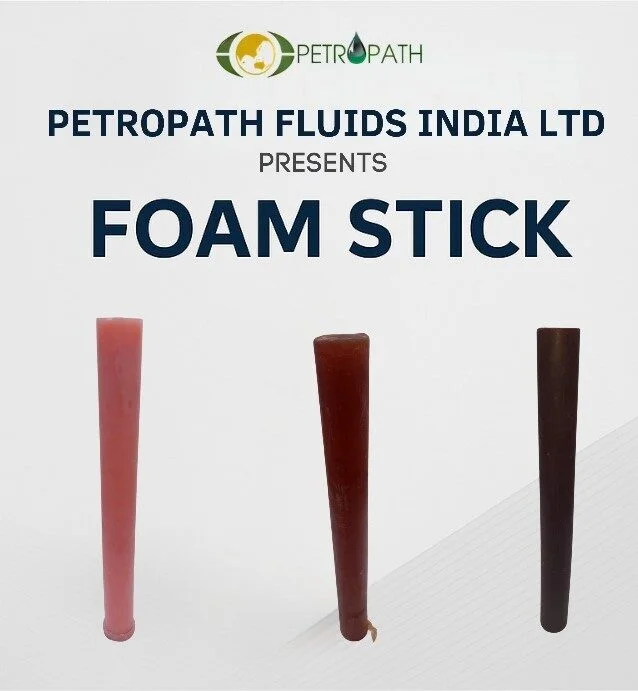
Foam sticks are solid, cylindrical chemical products formulated with specialized surfactants and foaming agents. They are introduced into a gas well where they gradually dissolve under downhole conditions.
As the active chemicals dissolve, they interact with accumulated liquids and generate foam. The resulting foam has a lower effective density than the liquid column, helping reduce hydrostatic pressure and allowing the well’s gas flow to carry liquids toward the surface.
This makes Foam Sticks for Oil & Gas Workover Operations particularly useful for wells experiencing liquid loading, declining reservoir pressure, intermittent production, or difficulty maintaining continuous gas flow.
How Do Foam Sticks Work in Gas Wells?
The effectiveness of Foam Sticks for Oil & Gas Workover Operations comes from a straightforward liquid-unloading mechanism.
1. Drop-In Application
The foam stick is introduced into the wellbore using an appropriate field application method based on well conditions.
2. Controlled Dissolution
Once inside the well, the stick gradually dissolves and releases its active foaming components.
3. Foam Generation
The surfactants interact with the water and other liquids present in the well to generate foam.
4. Liquid Unloading
The generated foam reduces the effective density of the liquid column, helping gas carry accumulated liquids toward the surface.
5. Improved Gas Flow
As liquid loading decreases, hydrostatic pressure is reduced and gas can flow more effectively.
Because of this simple mechanism, Soap Sticks for Gas Wells can be incorporated into suitable gas well production and workover programs without requiring a complex artificial lift installation.
Key Benefits of Foam Sticks for Oil & Gas Workover Operations
Using Foam Sticks for Oil & Gas Workover Operations can provide several operational and economic advantages.
Improved Gas Production
Liquid accumulation can restrict gas flow and contribute to declining production. Foam sticks assist with liquid unloading, helping restore productive flow in suitable wells.
Cost-Effective Well Treatment
Compared with installing complex artificial lift equipment, foam-based liquid unloading can be a comparatively economical approach for selected wells.
Simple Application
Foam sticks are easy to transport, store, and apply when the appropriate field procedure is followed. Their solid form also makes handling convenient compared with some liquid chemical treatments.
Reduced Operational Intervention
The treatment can reduce the need for extensive equipment installation and may support more flexible well maintenance programs.
Suitable for Mature and Marginal Wells
Low-pressure and mature wells can experience increasing liquid-loading problems. Foam Sticks for Oil & Gas Workover Operations can provide an economical option for supporting production in appropriate well conditions.
Applications in Oil and Gas Operations
Foam sticks can be used across several production and workover applications.
Gas Well Liquid Unloading
One of the primary applications is removing accumulated water and condensate from gas wells. This helps reduce liquid loading and supports continued gas flow.
Post-Workover Well Clean-Up
Following selected workover activities, accumulated liquids may affect well recovery. Foam treatments can support the liquid-unloading process and help the well return to production.
Mature Gas Well Production
As reservoir pressure declines, wells may lose the energy required to naturally lift liquids. Gas Well Dewatering Solutions such as foam sticks can help address this challenge.
Production Optimization
Foam sticks can form part of a broader production optimization program where operators want to improve well performance without immediately investing in major artificial lift infrastructure.
Foam Sticks vs. Conventional Artificial Lift
Selecting a liquid-unloading method depends on well depth, pressure, liquid volume, gas rate, temperature, chemistry, and other operating conditions.
| Parameter | Foam Sticks | Artificial Lift |
|---|---|---|
| Initial Cost | Generally lower | Generally higher |
| Installation | Simple application | Equipment installation required |
| Maintenance | Relatively minimal | Equipment maintenance required |
| Flexibility | High for suitable wells | Depends on system |
| Equipment Requirement | Limited | More extensive |
This comparison does not mean foam sticks replace every artificial lift system. Instead, they can provide a practical option for suitable wells where liquid loading is affecting production.
Why Choose Petropath Fluids (India) Ltd.?
Petropath Fluids (India) Ltd. focuses on supplying specialized oilfield chemical solutions designed for demanding field applications. Our foam-stick solutions are developed with attention to product consistency, application requirements, and operational performance.
When selecting Workover Chemicals for Oil and Gas, operators should consider product quality, well conditions, treatment objectives, chemical compatibility, and technical support.
Petropath supports customers with:
- Consistent product quality
- Application-focused formulations
- Technical guidance
- Cost-conscious solutions
- Reliable oilfield chemical supply
Our objective is to help operators select practical chemical solutions that support safer, more efficient, and productive well operations.
How to Select the Right Foam Stick
Not every gas well has the same liquid-loading problem. Before selecting a foam stick, operators should evaluate factors such as:
- Well depth and temperature
- Type and volume of accumulated liquids
- Gas production rate
- Reservoir and flowing pressure
- Water chemistry
- Wellbore conditions
- Desired treatment frequency
Proper evaluation helps determine whether Liquid Unloading Chemicals are suitable and what treatment approach should be considered.
FAQs
Conclusion
Foam Sticks for Oil & Gas Workover Operations offer a simple and economical approach to managing liquid loading in suitable gas wells. By generating foam and helping reduce the effective hydrostatic pressure of accumulated liquids, they can support liquid unloading and improved gas flow.
For mature, marginal, and low-pressure wells, this approach can be an important part of a broader gas production optimization strategy. Compared with more complex solutions, foam sticks can offer operational flexibility with limited equipment requirements.
Petropath Fluids (India) Ltd. supplies Soap Sticks for Gas Wells, gas well dewatering products, and specialized Workover Chemicals for Oil and Gas applications. With the right product selection and field application strategy, foam-based liquid unloading can help operators maintain production and improve well performance.
Choose Foam Sticks for Oil & Gas from Petropath Fluids India Ltd – trusted by leading operators for reliable performance and long-term savings.
We provide worldwide delivery, custom configurations, and technical support tailored to your operational needs.