
Corrosion Inhibitor for Oil & Gas Lines: Advanced Pipeline Protection Technology
In the oil and gas industry, pipelines are the backbone of production and transportation systems. However, these pipelines are constantly exposed to harsh environments that cause severe corrosion. Produced fluids often contain carbon dioxide (CO₂), hydrogen sulfide (H₂S), oxygen, salts, acids, and water, all of which accelerate metal degradation.
A Corrosion Inhibitor for Oil & Gas Lines plays a critical role in preventing internal corrosion and maintaining pipeline integrity. Advanced chemical solutions such as PP CORROSION INHIBITOR provide reliable protection by forming a protective barrier on metal surfaces, preventing corrosive agents from attacking steel.
By implementing a high-performance pipeline corrosion inhibitor oil and gas solution, operators can significantly reduce corrosion rates, extend equipment lifespan, and maintain safe and efficient operations across oilfield infrastructure.
Understanding Pipeline Corrosion in Oil & Gas Systems
Corrosion is one of the most costly operational challenges in oil and gas production. Pipelines transporting crude oil, natural gas, and multiphase fluids are continuously exposed to corrosive elements.
Common corrosion sources include:
CO₂ corrosion which forms carbonic acid in the presence of water
H₂S corrosion leading to sulfide stress cracking
Oxygen attack accelerating electrochemical corrosion reactions
Microbial corrosion caused by sulfate-reducing bacteria
High salinity produced water that increases corrosion rates
Without effective protection, these factors can cause pipeline leaks, equipment damage, environmental hazards, and expensive shutdowns.
Using a Corrosion Inhibitor for Oil & Gas Lines offers a proactive approach to corrosion control by protecting internal metal surfaces and ensuring long-term infrastructure reliability.
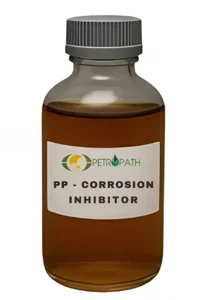
What is PP CORROSION INHIBITOR?
PP CORROSION INHIBITOR is a high-performance oilfield corrosion inhibitor chemical developed to protect pipelines, flow lines, tubing, casing, and processing equipment across upstream, midstream, and downstream operations.
This specialized corrosion control chemical contains advanced film-forming organic molecules that strongly adhere to metal surfaces. Once applied, these molecules form a durable protective layer that isolates steel from corrosive fluids.
As a result, the Corrosion Inhibitor for Oil & Gas Lines significantly reduces corrosion reactions and ensures long-term crude oil pipeline corrosion protection even in harsh oilfield environments.
How Corrosion Inhibitors Protect Oil & Gas Pipelines
The protection mechanism of a Corrosion Inhibitor for Oil & Gas Lines involves a multi-step chemical process designed to shield metal surfaces from corrosive agents.
1. Surface Adsorption
Active inhibitor molecules attach to exposed steel surfaces within pipelines and equipment.
2. Protective Film Formation
The molecules organize themselves into a continuous hydrophobic film that covers the metal surface.
3. Barrier Protection
This film blocks corrosive substances such as CO₂, H₂S, oxygen, and produced water from contacting the steel.
4. Corrosion Rate Reduction
Electrochemical reactions responsible for metal degradation are slowed down, significantly reducing corrosion rates.
This advanced mechanism makes the Corrosion Inhibitor for Oil & Gas Lines highly effective for both sweet and sour oilfield environments.
Key Features of PP Corrosion Inhibitor
PP CORROSION INHIBITOR offers several performance advantages for oilfield pipeline protection.
High-efficiency pipeline corrosion inhibitor oil and gas solution
Excellent resistance to CO₂ and H₂S corrosion inhibitor oilfield conditions
Forms a durable molecular protective film
Compatible with crude oil, natural gas, and multiphase fluids
Provides reliable crude oil pipeline corrosion protection
Effective in high-pressure and high-temperature environments
Suitable for sweet and sour oilfield systems
Reduces pipeline maintenance and downtime
Enhances operational safety and equipment reliability
These features make it a trusted oilfield corrosion inhibitor chemical for modern pipeline protection programs.
Applications of Corrosion Inhibitor for Oil & Gas Lines
A Corrosion Inhibitor for Oil & Gas Lines is widely used across multiple oil and gas industry operations.
Oil & Gas Production Systems
Wellhead corrosion protection
Flow line corrosion control
Production tubing and casing protection
Downhole corrosion inhibitor treatments
Pipeline Infrastructure
Crude oil pipelines
Natural gas transmission pipelines
Multiphase transportation pipelines
Subsea pipeline systems
Storage and Transportation
Crude oil storage tanks
Tank farm pipelines
Oil transfer terminals
Refinery and Processing Plants
Process pipelines
Heat exchangers
Separation vessels
Water Injection Systems
Produced water pipelines
Injection wells
Disposal water transport systems
These applications demonstrate how a pipeline corrosion inhibitor oil and gas solution supports corrosion control across critical infrastructure
Recommended Dosage and Injection Methods
The typical treatment dosage for a Corrosion Inhibitor for Oil & Gas Lines ranges between 25 and 200 ppm depending on operational conditions.
Key factors influencing dosage include:
Water cut in crude oil production
CO₂ concentration levels
Presence of H₂S
Operating pressure and temperature
Pipeline flow velocity
Existing corrosion rate
Common injection methods include:
Continuous chemical injection pumps
Batch pipeline treatment programs
Wellhead injection systems
Downhole capillary string injection
Pipeline pigging treatments
Field testing and corrosion monitoring are recommended to determine optimal dosage levels for maximum pipeline protection.
Advantages of Using Corrosion Inhibitors in Oil & Gas Pipelines
Implementing a high-quality Corrosion Inhibitor for Oil & Gas Lines provides significant operational benefits.
Extends the service life of pipelines and equipment
Prevents corrosion-related failures
Reduces maintenance and repair costs
Improves operational reliability
Enhances environmental and workplace safety
Ensures long-term crude oil pipeline corrosion protection
For oilfield operators, corrosion inhibitors represent a cost-effective strategy for maintaining asset integrity and operational efficiency.
Corrosion inhibitors are specialized chemical additives used in the oil and gas sector to protect pipelines, downhole tubing, and refineries against degradation caused by water, CO₂, H₂S, and organic acids.
A corrosion inhibitor is a chemical compound added to liquids or gases to slow down or prevent the degradation of metals. It works by adsorbing onto the metal surface to form a protective film, altering electrochemical reactions, or neutralizing corrosive elements like oxygen and acids.
Corrosion inhibitors are chemical compounds added in small amounts to a fluid or environment to dramatically slow down the rate of metal degradation. They generally function by forming a protective surface barrier, neutralizing corrosive elements, or interfering with the electrochemical reactions that cause metal oxidation.
Hazard Statements : Flammable liquid and vapour. May be fatal if swallowed and enters airways. Causes skin irritation. Causes serious eye damage.
In the upstream and midstream oil and gas sectors, C1, C2, C3, and C4 refer to the number of carbon atoms in hydrocarbon molecules. These light hydrocarbons are naturally gaseous at standard temperature and pressure and make up the most valuable components of natural gas and natural gas liquids (NGLs)
Why Choose Petropath Oilfield Chemicals?
Petropath Oilfield Chemicals is a trusted supplier of advanced chemical solutions for oil and gas operations. With deep expertise in corrosion control technologies, the company provides reliable products designed for demanding oilfield environments.
Petropath offers:
High-performance oilfield corrosion inhibitor chemical formulations
Consistent manufacturing quality
Global supply capabilities
Technical support for corrosion management programs
Customized chemical solutions for oilfield applications
Their expertise ensures effective pipeline corrosion inhibitor oil and gas protection across critical infrastructure systems.
Conclusion
Pipeline corrosion remains one of the most serious challenges in oil and gas operations. Without proper protection, corrosive fluids can quickly damage pipelines, cause leaks, and disrupt production.
Using a reliable Corrosion Inhibitor for Oil & Gas Lines such as PP CORROSION INHIBITOR provides a proven solution for internal corrosion control. By forming a protective molecular film on metal surfaces, this advanced chemical technology reduces corrosion rates and extends pipeline service life.
For companies seeking dependable crude oil pipeline corrosion protection, investing in high-performance corrosion inhibitors ensures safer, more efficient, and long-lasting oilfield operations.