
Ultimate Guide to Oil Soluble Demulsifier for Efficient Crude Oil Emulsion Treatment
Efficient crude oil production depends on maintaining high-quality oil while minimizing water contamination throughout extraction, transportation, storage, and refining. One of the biggest operational challenges in the petroleum sector is the formation of stable water-in-oil emulsions. These emulsions reduce production efficiency, increase processing costs, and negatively affect downstream equipment performance.
An Oil Soluble Demulsifier is a specialized chemical solution developed to break these stubborn emulsions quickly and effectively. By separating water from crude oil, it helps improve crude quality, reduce Basic Sediment & Water (BS&W), protect processing equipment, and optimize overall production.
Whether used in upstream production facilities, midstream transportation systems, or downstream refineries, an Oil Soluble Demulsifier has become an essential part of modern crude oil processing. This guide explains how it works, its benefits, applications, dosage recommendations, and why selecting the right formulation is critical for long-term operational success.
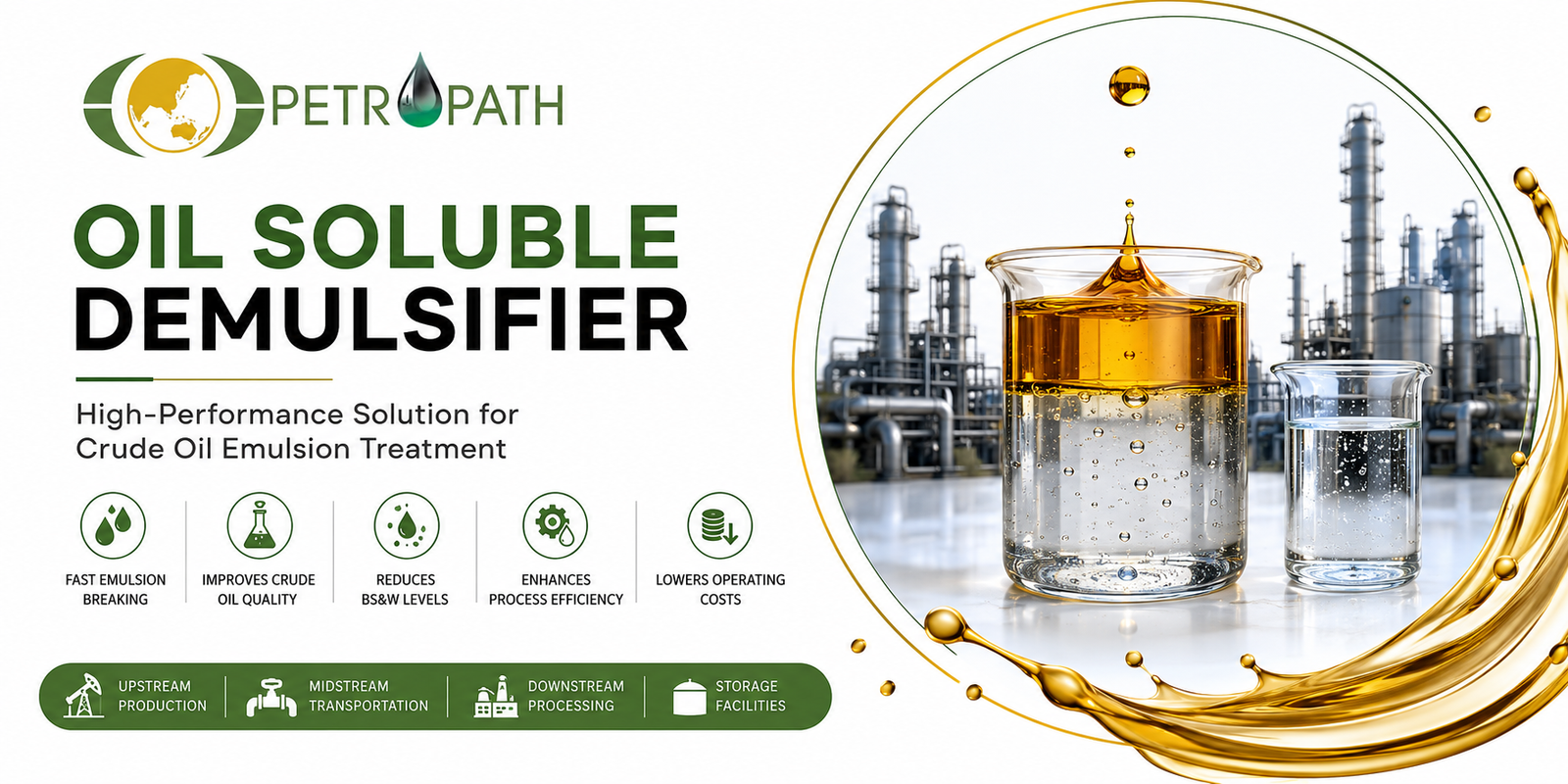
An Oil Soluble Demulsifier is a carefully engineered chemical formulation designed to separate water from crude oil emulsions. During crude oil production, turbulence, pressure changes, and naturally occurring surface-active materials such as asphaltenes and resins create highly stable emulsions that are difficult to separate naturally.
The Oil Soluble Demulsifier penetrates the protective film surrounding water droplets, destabilizes the emulsion, and allows tiny water droplets to merge into larger ones. Once coalesced, gravity enables efficient separation of oil and water, producing cleaner crude oil suitable for transportation and refining.
This process significantly improves dehydration efficiency while reducing impurities and operational challenges.
Why Crude Oil Emulsion Treatment Matters
Stable crude oil emulsions create several technical and financial challenges across petroleum operations. Excess water trapped inside crude oil increases viscosity, lowers processing efficiency, accelerates corrosion, and raises transportation costs.
Without proper treatment, emulsions may lead to:
- Higher BS&W levels
- Reduced crude oil value
- Increased separator load
- Pipeline corrosion
- Processing delays
- Higher refinery operating costs
- Greater maintenance requirements
- Lower production efficiency
Using an Oil Soluble Demulsifier ensures rapid emulsion breaking, enabling operators to maintain consistent production while reducing operating expenses.
How an Oil Soluble Demulsifier Works
The effectiveness of an Oil Soluble Demulsifier depends on its ability to alter the oil-water interface through several stages.
Adsorption
Demulsifier molecules quickly migrate to the interface between crude oil and water droplets.
Displacement
The formulation replaces naturally occurring emulsifying agents such as resins, waxes, and asphaltenes that stabilize the emulsion.
Film Breakdown
The protective interfacial film weakens and eventually ruptures, releasing trapped water droplets.
Coalescence
Small water droplets merge into larger droplets that separate more easily under gravity.
Complete Separation
Water settles at the bottom while dehydrated crude oil remains at the top, allowing efficient removal and improved oil quality.
Major Benefits of Using an Oil Soluble Demulsifier
Selecting a premium Oil Soluble Demulsifier offers numerous operational and financial advantages.
Faster Emulsion Breaking
Rapid separation minimizes processing time and improves plant productivity.
Improved Crude Oil Quality
Cleaner crude oil contains significantly lower water and sediment content, increasing market value.
Reduced BS&W
Lower Basic Sediment & Water levels help meet transportation and refinery specifications.
Enhanced Equipment Performance
Efficient dehydration improves separator, heater treater, desalting unit, and electrostatic dehydrator performance.
Lower Operating Costs
Reduced chemical consumption, shorter processing cycles, and improved efficiency contribute to overall cost savings.
Better Water Clarity
Effective separation produces cleaner produced water, simplifying wastewater treatment processes.
Increased Oil Recovery
Recovering additional oil from emulsions enhances overall production efficiency and profitability.
Global Applications of Oil Soluble Demulsifier
An Oil Soluble Demulsifier is widely used across every stage of petroleum production and processing.
Upstream Oil Production
During production, it supports:
- Wellhead treatment
- Production separators
- Free water knockout systems
- Heater treaters
- Gathering stations
Midstream Transportation
Pipeline operators use demulsifiers for:
- Crude stabilization
- Flow assurance
- Reduced viscosity
- Pipeline efficiency improvement
Downstream Processing
Refineries utilize demulsifiers in:
- Crude desalting
- Electrostatic dehydrators
- Distillation feed preparation
- Pre-refinery dehydration
Storage Facilities
Storage terminals benefit from:
- Tank dehydration
- Water removal
- Sludge reduction
- Improved crude storage quality
Enhanced Oil Recovery Operations
Specialized formulations perform effectively in:
- Heavy crude production
- Polymer flooding
- Water flooding projects
- Mature oilfields
Recommended Dosage and Application
The ideal dosage of an Oil Soluble Demulsifier depends on several operational variables.
Typical dosage ranges between:
50–200 ppm
Factors influencing dosage include:
- Crude oil characteristics
- Water cut percentage
- Temperature
- Pressure
- Emulsion stability
- Production rate
- Salinity
- Equipment configuration
Laboratory bottle testing is recommended before field application to determine the most effective treatment program.
Injection Methods
The Oil Soluble Demulsifier can be introduced using multiple injection systems depending on operational requirements.
Common application methods include:
- Continuous chemical injection pumps
- Wellhead dosing systems
- Pipeline injection
- Batch treatment
- Storage tank treatment
- Separator injection
- Production manifold injection
These flexible methods allow seamless integration into existing production facilities.
Storage and Safe Handling
Proper storage helps maintain chemical stability and performance.
Recommended practices include:
- Store in a cool, dry location.
- Keep containers tightly sealed.
- Protect from excessive heat and direct sunlight.
- Avoid moisture contamination.
- Wear suitable PPE including gloves, protective clothing, and safety goggles during handling.
- Follow local environmental and safety regulations.
Under recommended storage conditions, most formulations provide a shelf life of up to 24 months.
Choosing the Right Oil Soluble Demulsifier
Not every crude oil behaves the same way. Differences in API gravity, wax content, asphaltene concentration, temperature, salinity, and production chemistry require customized chemical formulations.
A high-quality Oil Soluble Demulsifier should provide:
- Rapid water separation
- Stable performance under varying temperatures
- Low treatment dosage
- High compatibility with different crude types
- Reduced operating costs
- Improved refinery feed quality
- Excellent oil recovery
- Reliable long-term performance
Working with experienced technical specialists ensures the correct formulation is selected for your specific production conditions.
Why Modern Oilfields Depend on Oil Soluble Demulsifiers
As petroleum production becomes increasingly complex, operators require reliable chemical solutions that maximize efficiency while minimizing operational costs. Advanced demulsifier technology supports sustainable production by reducing chemical waste, improving equipment performance, lowering energy consumption, and enhancing crude oil quality.
From offshore platforms to onshore production facilities and large-scale refineries, an Oil Soluble Demulsifier remains one of the most effective solutions for improving oil-water separation and ensuring uninterrupted operations across the global energy industry.
FAQs
- Upstream (Oilfields): Separating formation water from extracted crude to meet pipeline specifications.
- Midstream: Treating crude during transportation or in storage tanks.
- Downstream: Pre-refinery salt and water removal to prevent corrosion in processing units
- Ethoxylated phenols
- Alkylphenol resins
- Modified polyols or block copolymers [1]
- Increase efficiency: Speed up the separation rate in separators and electrostatic coalescers.
- Improve quality: Help reduce bottom sediment and water (BS&W) content to commercial specifications.
- Reduce costs: Lessen the need for thermal heating and prevent downstream equipment corrosion.
Conclusion
Efficient emulsion treatment is essential for maximizing crude oil production, protecting valuable equipment, and reducing processing costs. A premium Oil Soluble Demulsifier delivers rapid water separation, lower BS&W levels, improved crude quality, and enhanced operational efficiency throughout the petroleum value chain.
Whether applied in upstream production, pipeline transportation, storage terminals, or downstream refining, the right demulsifier helps operators achieve reliable performance, higher oil recovery, and long-term cost savings. Investing in an advanced Oil Soluble Demulsifier is a strategic decision that supports cleaner crude oil, smoother operations, and improved profitability in demanding production environments.
Contact Us
Looking for a reliable solution to improve crude oil emulsion treatment and optimize oil-water separation? Our technical experts can help you select the right Oil Soluble Demulsifier for your operational requirements. Contact us today to discuss your application, request technical guidance, or learn more about our global supply capabilities.