
Cementing Bentonite for Oilfield: 9 Benefits for Reliable Well Cementing Operations
Introduction
Cementing Bentonite for Oilfield is one of the most important additives used in modern oil and gas well cementing. As drilling projects become deeper and more technically demanding, maintaining a stable cement slurry and achieving complete zonal isolation are critical for long-term well performance. Selecting the right cementing additive directly impacts well integrity, operational efficiency, and production reliability.
PP-BEN-CEM Cementing Bentonite for Oilfield is a premium sodium bentonite developed specifically for oil well cementing applications. Manufactured with a high montmorillonite content, it offers rapid hydration, excellent swelling capacity, superior slurry stability, and outstanding fluid loss control. These properties help operators achieve consistent cement placement while reducing operational risks.
Whether used for primary cementing, remedial cementing, or specialized well integrity programs, PP-BEN-CEM provides dependable performance in both onshore and offshore environments. Its compatibility with freshwater and saltwater cement systems makes it a trusted solution for challenging drilling conditions worldwide.
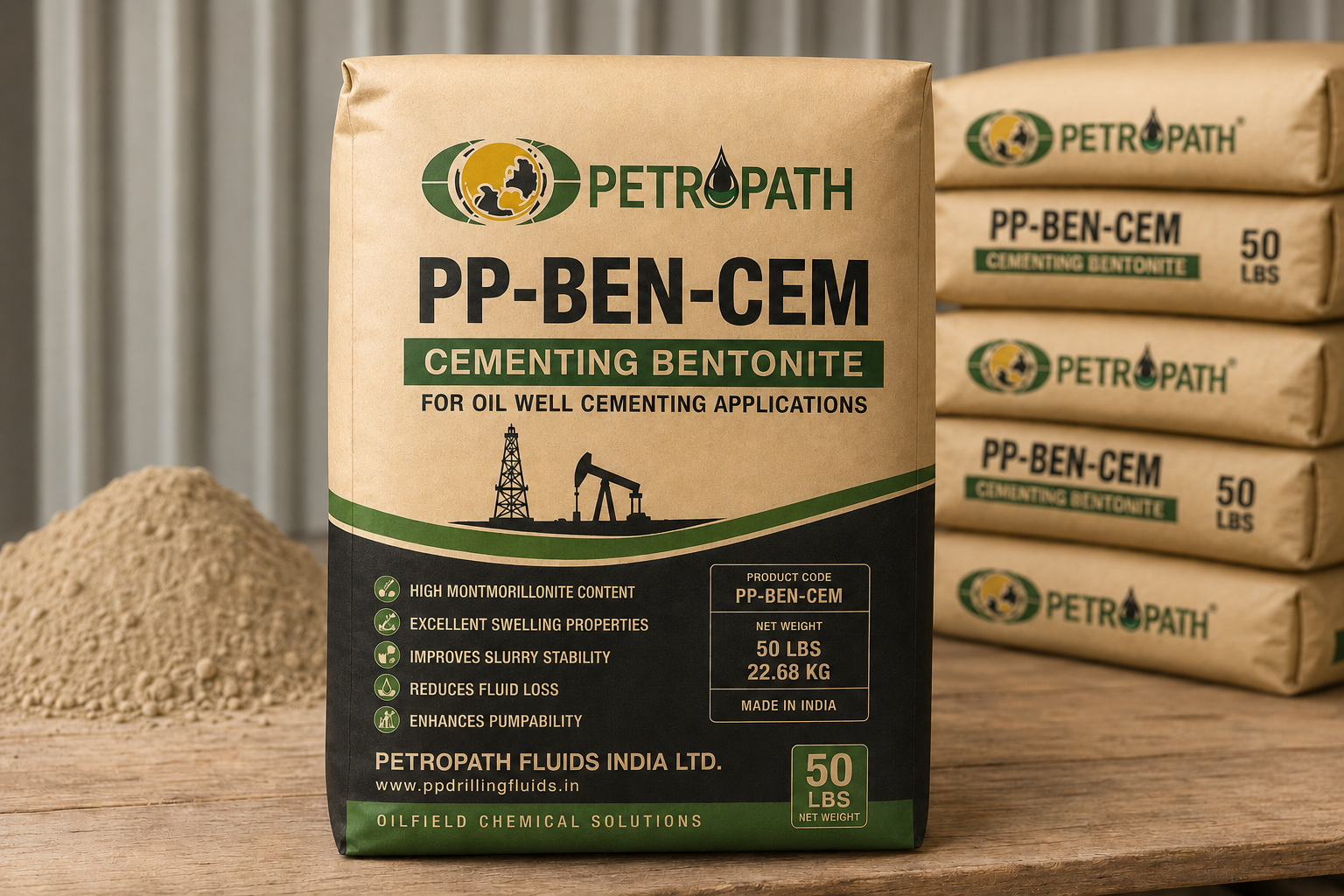
What is Cementing Bentonite for Oilfield?
Cementing Bentonite for Oilfield is a specially processed sodium bentonite designed to improve the physical properties of cement slurries used during oil and gas well cementing. Unlike ordinary bentonite, this oilfield-grade product is engineered to deliver controlled rheology, improved suspension, and consistent slurry performance under demanding field conditions.
When hydrated, bentonite particles expand to create a stable colloidal gel structure. This increases slurry viscosity, reduces free water separation, prevents particle settling, and enhances slurry uniformity throughout the pumping process.
These characteristics make it an essential Oil Well Cementing Bentonite for maintaining cement quality and improving wellbore sealing.
Why Cementing Bentonite Matters in Oilfield Operations
Successful cementing is essential for isolating producing zones, protecting groundwater, supporting casing strings, and preventing fluid migration between formations.
Without proper slurry conditioning, operators may experience:
- Poor cement bonding
- Excessive fluid loss
- Slurry segregation
- Free water separation
- Reduced pumpability
- Weak zonal isolation
- Increased non-productive time (NPT)
Using Cementing Bentonite for Oilfield significantly reduces these risks while improving the overall efficiency of cementing operations.
9 Benefits of Cementing Bentonite for Oilfield
1. Excellent Slurry Stability
One of the biggest advantages of Cementing Bentonite for Oilfield is its ability to maintain a homogeneous cement slurry. The hydrated gel structure keeps cement particles evenly suspended, preventing settling during mixing and pumping.
2. Superior Fluid Loss Control
Fluid loss into permeable formations can weaken cement quality and reduce placement efficiency.
As a high-performance Cement Slurry Additive, PP-BEN-CEM minimizes filtration loss while maintaining slurry consistency throughout the cementing process.
3. Enhanced Pumpability
The product improves slurry flow characteristics without excessive thickening. Operators benefit from smoother pumping, reduced pressure fluctuations, and improved placement accuracy.
4. Higher Slurry Yield
PP-BEN-CEM increases slurry volume through its exceptional hydration capability, helping optimize material usage while maintaining desired cement properties.
This makes it an economical Well Cementing Additive for large-scale operations.
5. Improved Zonal Isolation
Proper zonal isolation prevents fluid migration between geological formations.
The stable slurry produced by Cementing Bentonite for Oilfield promotes stronger cement sheath formation and long-term well integrity.
6. Reduced Free Water Separation
Free water can create channels that weaken cement bonding.
Rapid hydration minimizes water separation and helps achieve uniform cement placement throughout the wellbore.
7. Better Suspension Properties
The high montmorillonite content improves suspension characteristics, ensuring cement particles remain evenly distributed throughout pumping operations.
This contributes to more reliable cement placement.
8. Compatibility with Various Cement Systems
PP-BEN-CEM is compatible with:
- Freshwater cement slurries
- Saltwater systems
- Cement retarders
- Fluid loss additives
- Cement dispersants
- Conventional oilfield cement additives
Its versatility makes it suitable for numerous global drilling projects.
9. Reliable Performance in Challenging Conditions
Whether working in deep wells, high-temperature environments, or offshore drilling projects, Cementing Bentonite for Oilfield consistently delivers dependable slurry conditioning and improved operational efficiency.
How Cementing Bentonite Works
The effectiveness of Cementing Bentonite for Oilfield comes from its sodium montmorillonite composition.
When mixed with water:
- Bentonite particles hydrate rapidly.
- The particles expand significantly.
- A stable colloidal gel network develops.
- Slurry viscosity increases.
- Cement particles remain suspended.
- Fluid loss decreases.
- Pumpability improves.
- Cement placement becomes more uniform.
This hydration process creates a stronger and more stable cement slurry that performs efficiently throughout the cementing operation.
Typical Applications
PP-BEN-CEM is widely used in numerous oilfield cementing operations, including:
Primary Cementing
Provides stable slurry properties for effective casing cementing and long-term zonal isolation.
Remedial Cementing
Supports squeeze cementing and repair jobs requiring dependable suspension and controlled rheology.
Well Integrity Programs
Improves cement sheath quality and enhances long-term well performance.
Offshore Cementing
Performs consistently in demanding offshore drilling environments.
High-Performance Cement Slurry Design
Used by engineers to optimize slurry yield, stability, and pumpability.
Physical Properties
Typical performance characteristics include:
| Property | Typical Result |
|---|---|
| Montmorillonite Content | 90% |
| Moisture Content | 8% |
| Swelling Volume | 28 ml |
| Marsh Viscosity | 38 sec |
| API Water Loss Yield | 125 bbl/ton |
| pH | 8.0 |
| Passing 200 Mesh | 98% |
These values demonstrate the high-quality manufacturing standards of PP-BEN-CEM.
Why Choose PP-BEN-CEM?
PP-BEN-CEM has been engineered specifically for professional oilfield cementing applications.
Key advantages include:
- Premium sodium bentonite quality
- High swelling performance
- Excellent hydration characteristics
- Improved slurry rheology
- Reduced fluid loss
- Enhanced cement stability
- Reliable global performance
- Consistent manufacturing quality
- Technical application support
- Worldwide supply capability
These benefits help operators improve cementing efficiency while reducing operational risks.
Best Practices for Maximum Performance
To achieve the best results when using Cementing Bentonite for Oilfield, operators should:
- Design slurry formulations according to well conditions.
- Maintain recommended mixing procedures.
- Monitor slurry density and rheology.
- Select compatible additives.
- Follow proper quality control during mixing.
- Optimize treatment concentrations based on project requirements.
Proper slurry design ensures maximum performance and dependable cement placement.
- Yield Improvement: It substantially increases the volume of slurry obtained per sack of cement, lowering material costs.
- Fluid Loss Control: It swells to create a tighter matrix, preventing the liquid phase of the cement from leaking into permeable formations.
- Slurry Stability: It acts as a suspending agent to prevent the heavier cement particles from settling out before the slurry sets.
- Reduced Compressive Strength: Higher concentrations of bentonite significantly decrease the final mechanical strength of the cured cement sheath.
- Higher Water Requirement: Because bentonite is highly absorbent, adding it requires mixing in more water, which directly leads to lower density and compressive strength.
- Freshwater vs. Saltwater: It yields best in fresh water. High concentrations of salts, calcium, or magnesium in the mixing water will destroy bentonite’s swelling capacity (often requiring specialized saltwater extenders instead).
Typically, bentonite is added in concentrations ranging from 1% to 16% by weight of the cement (BWOC). The exact amount depends heavily on whether the primary goal is a standard lightweight cement or an ultra-lightweight slurry for weak or depleted formations
When lighter slurries are required but the strength reduction of bentonite is unacceptable, engineers often use specialized microspheres, pozzolans, or diatomaceous earth as alternatives to achieve lightweight properties without the high water demand.
Conclusion
Cementing Bentonite for Oilfield plays a crucial role in achieving efficient, reliable, and high-quality well cementing operations. Its superior hydration, excellent slurry stability, enhanced fluid loss control, and improved pumpability make it an indispensable additive for today’s demanding drilling environments.
PP-BEN-CEM delivers outstanding performance for primary cementing, remedial cementing, and well integrity projects across onshore and offshore applications. With premium sodium bentonite quality, consistent manufacturing standards, and global supply capabilities, it helps operators maximize cementing efficiency while ensuring long-term well integrity.
For organizations seeking dependable cement slurry performance, PP-BEN-CEM Cementing Bentonite for Oilfield is a proven solution that supports safer operations, improved productivity, and lasting well success.
Call to Action
Improve Your Cementing Performance with PP-BEN-CEM
Looking for a premium Cementing Bentonite for Oilfield that delivers superior slurry stability, fluid loss control, and long-term well integrity? PP-BEN-CEM from Petropath Fluids India Limited is engineered to meet the demands of modern oil and gas cementing operations.
Contact our technical team today to discuss your project requirements, request product specifications, or receive expert guidance on selecting the right cementing solution for your well conditions.