
Non-Invasive Fluid Additive: Advanced Solutions for Wellbore Stability and Formation Protection
Introduction
Modern oil and gas drilling requires effective drilling fluid management to maintain wellbore stability, minimize formation damage, and improve operational efficiency. A Non-Invasive Fluid Additive is designed to help control filtrate invasion into permeable formations while supporting the integrity of the wellbore and protecting reservoir productivity.
During drilling, excessive fluid penetration can alter formation properties, reduce permeability, contribute to differential sticking, and increase non-productive time (NPT). These challenges become particularly important when drilling through depleted reservoirs, fractured formations, and sensitive geological zones.
PP – NIFA from Petropath Fluids (India) Ltd. is a specialized fluid additive developed for fluid invasion control and wellbore sealing applications. By helping create a thin, low-permeability filter cake, this product supports controlled filtration and helps reduce unwanted interaction between drilling fluids and the surrounding formation.
Selecting the right additive for a drilling fluid system can help operators improve drilling performance, manage operational risks, and protect valuable reservoir intervals.
What Is a Non-Invasive Fluid Additive?
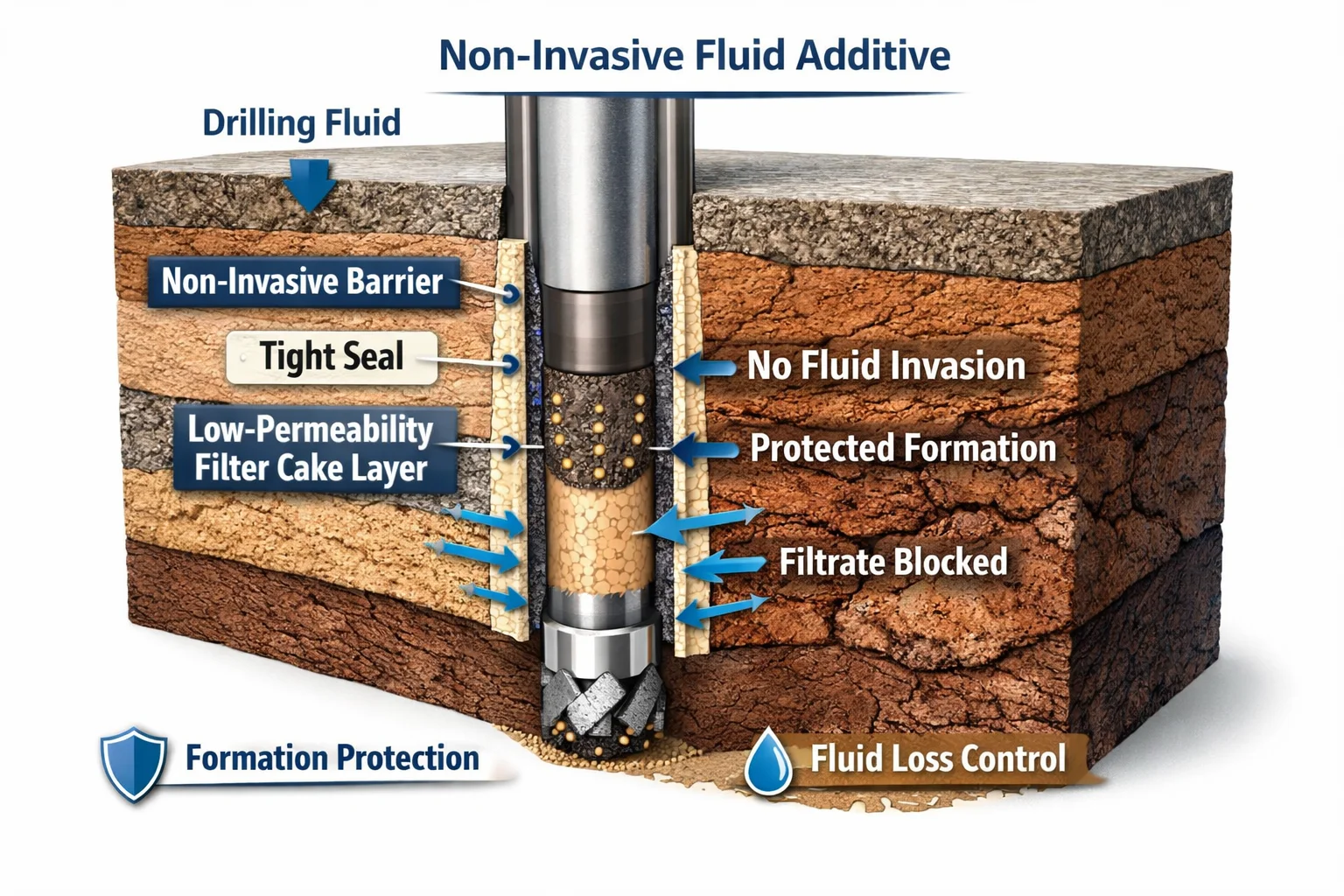
A Non-Invasive Fluid Additive is a drilling fluid treatment designed to limit the penetration of liquid filtrate into permeable formations. It helps create a sealing barrier at the wellbore interface, restricting fluid movement while supporting effective drilling fluid performance.
In conventional drilling operations, filtrate can enter formation pores, fractures, or other permeable pathways when fluid loss is not adequately controlled. This invasion may contribute to formation damage, reduced reservoir productivity, and wellbore instability.
An appropriately selected additive helps address these challenges by improving the sealing characteristics of the drilling fluid. Its effectiveness depends on factors such as particle-size distribution, formation permeability, mud composition, downhole temperature, and pressure conditions.
PP – NIFA is intended to support drilling fluid invasion control and formation protection in demanding oilfield applications.
How Does Non-Invasive Fluid Additive Work?
The performance of a Non-Invasive Fluid Additive depends on its ability to support effective sealing and filtration control.
1. Creates a Low-Permeability Barrier
The additive helps form a thin filter cake at the wellbore surface. This barrier reduces the movement of liquid filtrate into permeable formation layers when properly matched to the formation characteristics.
2. Controls Filtrate Invasion
Effective drilling mud fluid invasion control helps limit unnecessary fluid interaction with the formation. This is especially important in reservoir intervals where preserving permeability is a priority.
3. Supports Wellbore Stability
By helping regulate fluid penetration, the additive can support wellbore stability and reduce certain fluid-related drilling problems. Actual results depend on formation conditions and the overall drilling fluid formulation.
4. Helps Reduce Differential Sticking Risks
A properly designed filter cake can help reduce the conditions associated with differential sticking, particularly when fluid loss and filter-cake properties are appropriately managed.
Key Benefits of Non-Invasive Fluid Additive
Using a suitable Non-Invasive Fluid Additive can provide several operational advantages.
Improved Fluid Invasion Control
The additive supports controlled filtration by helping restrict filtrate penetration into permeable formations. This contributes to better management of drilling fluid interactions with the wellbore.
Enhanced Wellbore Stability
A suitable wellbore stability additive helps manage fluid-related instability and supports drilling through formations that require careful fluid control.
Better Formation Protection
Formation protection is essential when drilling through productive reservoir intervals. A suitable formation protection drilling chemical can help minimize filtrate-related damage and preserve formation characteristics.
Optimized Filter-Cake Properties
A thin, low-permeability filter cake can improve sealing performance while helping avoid excessive fluid penetration. Filter-cake quality should be evaluated under representative drilling conditions.
Reduced Operational Disruptions
Controlling fluid loss and managing filter-cake characteristics may help reduce problems associated with differential sticking, formation damage, and drilling interruptions.
Improved Drilling Fluid Performance
A filtration control additive for drilling mud can complement an appropriately formulated fluid system, supporting reliable performance across suitable drilling applications.
Typical Product Specifications of PP – NIFA
The following specifications summarize the product information provided for PP – NIFA.
| Parameter | Specification |
|---|---|
| Product Name | PP – NIFA |
| Product Type | Non-Invasive Fluid Additive |
| Appearance | Off-white to light brown powder or granules |
| Solubility | Water-dispersible |
| Primary Function | Fluid invasion control and wellbore sealing |
| Particle Size | Multimodal optimized distribution |
| Main Application | Filtration control and formation protection |
Actual product suitability should be confirmed against the latest technical data sheet and the requirements of the drilling operation.
Applications in Oil and Gas Drilling
Drilling Through Permeable Formations
A Non-Invasive Fluid Additive can support fluid invasion control in formations where excessive filtrate penetration may affect formation properties.
Reservoir and Formation Protection
In reservoir sections, limiting unwanted fluid invasion is an important part of protecting formation permeability. The additive may be incorporated into a suitable drilling fluid formulation to support this objective.
Drilling Through Fractured or Depleted Zones
Fractured and depleted formations can present additional fluid-loss challenges. Properly selected sealing additives can help manage fluid movement, subject to fracture characteristics and downhole conditions.
Water-Sensitive Formations
Some formations are sensitive to interaction with water-based drilling fluids. Fluid formulation, chemical compatibility, and filtration control should be assessed together to reduce the potential for formation instability.
Differential Sticking Prevention
Controlling filter-cake properties and managing fluid loss can help address factors that contribute to differential sticking. The additive should be used as part of an integrated drilling fluid management strategy.
Compatibility With Drilling Fluid Systems
PP – NIFA is described as suitable for consideration in several drilling fluid formulations, including:
Water-based mud systems
Polymer-based drilling fluids
Bentonite and clay-based mud systems
Other compatible drilling fluid formulations
Before field application, conduct appropriate laboratory testing to verify compatibility with the base fluid, polymers, viscosifiers, weighting materials, and other additives. Recommended dosage and treatment procedures should be established using product-specific technical guidance and representative operating conditions.
Packaging Options
PP – NIFA is available in the following packaging formats, according to the supplied product information:
25 kg bags
50 kg bags
1 MT jumbo bags
Packaging availability, storage conditions, and handling requirements should be confirmed when placing an order.
Why Choose PP – NIFA From Petropath Fluids (India) Ltd.?
Petropath Fluids (India) Ltd. provides oilfield solutions for drilling fluid management and related operational requirements. Its product portfolio includes drilling fluid additives, mud engineering chemicals, specialty oilfield chemicals, and laboratory testing equipment.
PP – NIFA is designed to support filtration control, wellbore sealing, and formation protection in suitable drilling applications. Its potential benefits include reduced filtrate invasion, improved filter-cake management, and support for wellbore stability when incorporated into a properly engineered drilling fluid system.
For optimal results, drilling teams should evaluate formation characteristics, mud properties, pressure and temperature conditions, and compatibility before selecting an additive.
Standard fluid loss additives (like starch or polymers) typically dissolve in the drilling fluid. In contrast, NIF additives are usually mostly dispersed. This dispersed nature allows them to physically bridge and seal pores in high-permeability or micro-fractured rock formations where conventional dissolved additives fail.
When drilling fluids invade a reservoir, they can cause clay swelling, block pores, and reduce well productivity. NIF additives seal the pores at the wellbore wall almost instantly, preventing the liquid phase of the mud from seeping deep into the rock matrix. This exclusion keeps the formation clean and preserves its original permeability.
Yes. Differential sticking often occurs when the drill pipe presses against the wellbore wall and the differential pressure forces drilling fluid into the rock, “glueing” the pipe in place. By creating a tight, impermeable barrier, NIF additives drastically reduce the pressure differential and minimize this risk.
NIF additives vary depending on the fluid system, but they typically consist of specialized blends. Common formulations utilize engineered polymers, finely graded powders, cellulosic materials, and fibrous or flaky materials that plug micro-fractures.
No. High-quality NIF additives—especially newer nano-additives and clay-free formulations—are designed to improve drilling efficiency. By keeping the wellbore stable and minimizing downhole trouble (such as pipe sticking or wellbore collapse), they allow operators to maintain a steady and often improved rate of penetration.
Conclusion
A Non-Invasive Fluid Additive can play an important role in managing filtrate invasion and supporting formation protection during oil and gas drilling. By helping develop a low-permeability sealing barrier, PP – NIFA is designed to support filtration control, wellbore stability, and effective drilling fluid management.
Selecting the appropriate additive requires consideration of formation permeability, fluid composition, downhole conditions, and laboratory test results. With suitable product selection and fluid engineering, operators can better manage formation-related risks and support reliable drilling operations.
Contact Petropath Fluids (India) Ltd. to discuss PP – NIFA, its suitability for your drilling fluid system, and the technical information required for your application.